

Austin Leonard — Quarterback, Class of 2036 — Monte Vista Elementary, Menifee, California
The two plays that decided Austin Leonard’s season opener both started out as disasters.
It was the across-town rival, second half, and twice the pocket broke down around him. Twice he was close enough to being sacked that most nine-year-old quarterbacks would already be on the ground. Both times he got out, found grass, and ran it to the end zone. Two long touchdowns, one game, and a win over the team you least want to lose to.
That is a remarkable way to close a game for anyone. It is a genuinely strange way to do it one year into playing football.
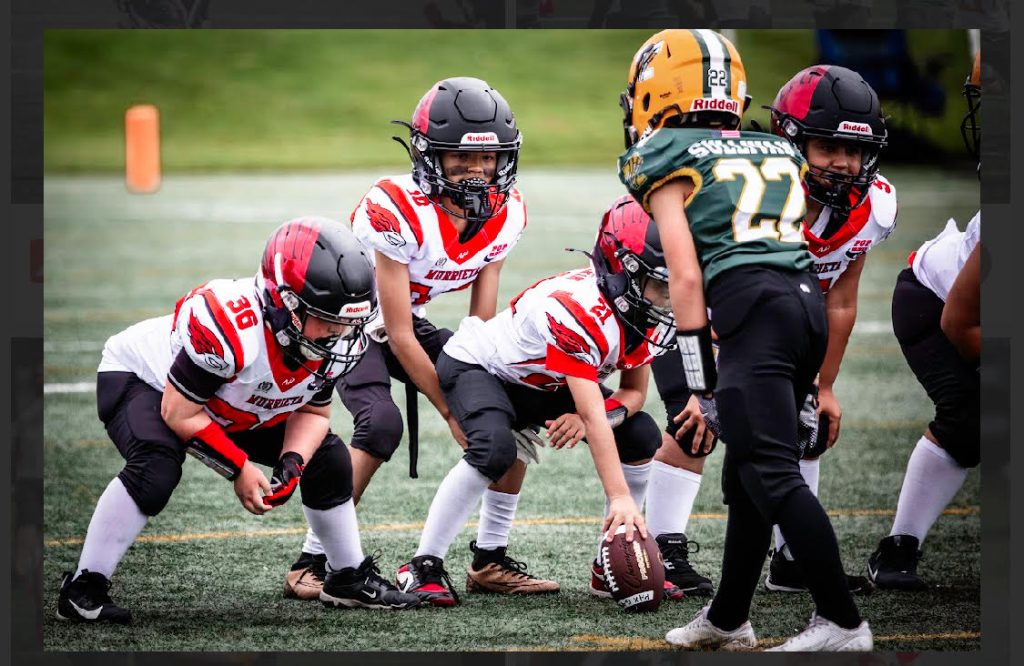
Leonard has been at this a single season. Before that — and still — he was a club soccer player, and a serious one. When his family explains why he took up football at all, the answer is competitive rather than sentimental: he wanted to play a sport where the best athletes were. It is a blunt reason and an honest one, and it tells you something about how he approaches a field.
It also explains some of what shows up on tape. A kid who has spent years reading angles in soccer, changing direction at speed, and finding the seam between two closing defenders is going to look different when a pocket collapses. The two touchdowns in that rivalry game were not designed runs. They were the plays a soccer player makes when the first plan dies — see the lane, accelerate through it, go.
What draws him to the position sounds like a kid who has already worked out the job description. “At quarterback I control the game,” he said, “and I am able to help make my teammates succeed.” Control and service, in one sentence, from a fourth grader. That is the whole position in miniature.
His family describes him as a dual-threat quarterback whose legs are currently the weapon — good vision, early recognition of lanes, the acceleration to turn a small crease into a long gain, and the instinct to keep looking for the throw while he does it. They are also clear-eyed about the rest of it: the passing game is still developing, and the ceiling depends on whether the mechanics and the decision-making catch up to the athleticism. That is a fair and useful assessment of nearly every nine-year-old dual threat in the country, and the honesty of it is a good sign.
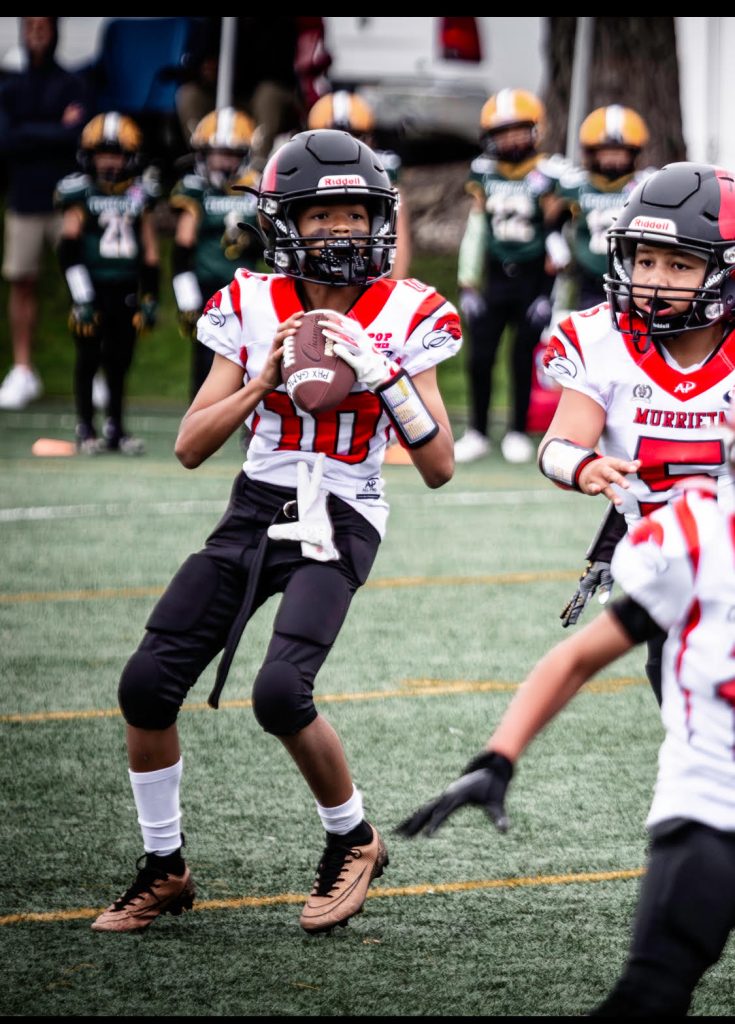
The harder adjustment has not been physical at all. Coming from high-level club soccer, Leonard ran into something he was not used to. Losing. His family says the football losses were difficult for him early on — and that he never let a loss become something that carried into the next week. Learning to lose without absorbing it is a skill that some athletes do not acquire until college, if ever.
He has landed with the right kind of coach for that stage. Austin’s head coach, Bryce Jones, is described in terms that have nothing to do with schemes: positive, and someone who makes everyone feel like part of the team. For a first-year football player who is still deciding how much of himself to invest in this sport, that is the coach you want.
One season in, with no camps and no private training yet, the record so far is simple. He can run, he can escape, and the first time his team really needed him, he took the rivalry game himself. Everything else is ahead of him.
For the Leonard Family: What an Upgrade Looks Like at This Age
Austin is in fourth grade. Nothing about this is recruiting, and it should not be — the Class of 2036 will not be a real recruiting class for the better part of a decade. What an upgraded QB Magazine membership does right now is more modest and, at this age, more worthwhile: it captures the beginning while the beginning is happening.
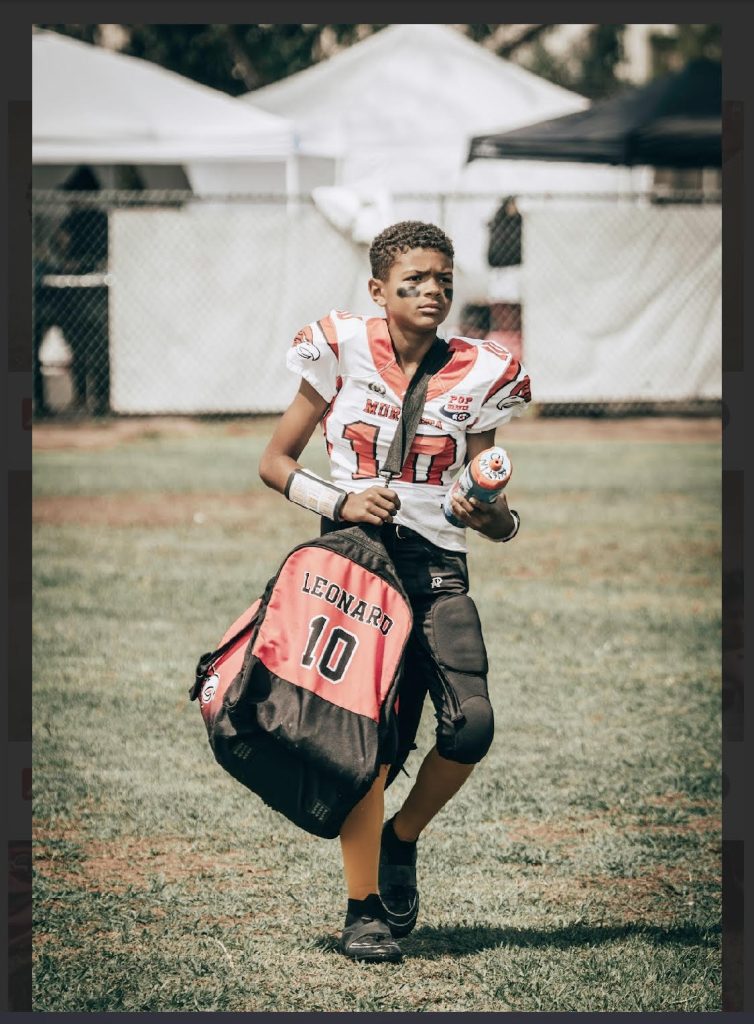
The piece families notice first is the custom graphics. Our design team builds player assets around your athlete specifically — his name, his class year, his team — clean, professional pieces made for sharing. A kid who won the opener against the rival with two second-half touchdowns should have something better to show for it than a clip somebody’s aunt filmed from forty yards away. These tend to end up on walls.
There is also the reach. Upgraded members have their content shared across QB Magazine’s platforms, where the audience is coaches, trainers, and people who follow the quarterback position closely. For a first-year player with no camp history yet, that is a way to be part of the wider quarterback world rather than only the Menifee one — which matters mostly because it puts him around the right ideas and the right people as he decides how far he wants to take this.
Over the years, it adds up into something no single post can be. A feature now, graphics as the seasons go, a profile that grows alongside him — together they become a record of development from the very first year. Very few players have that, because almost nobody starts documenting at nine. There is no deadline here and no reason to hurry. There is only the fact that this stretch is not repeatable.
And it stays. Phones die, videos get lost, nine-year-olds turn into seventeen-year-olds fast. A published feature does not move. Ten years from now, the story of a soccer player who went looking for the toughest competition, found himself at quarterback, and won his first big game on two plays that should have been sacks will still be there, exactly as it happened, with Coach Jones in it.
More info: quarterbackmagazine.com/memberships