

QB Magazine Athlete Feature
There is a version of the quarterback position that sounds like a chore — read the coverage, check the leverage, find the answer. Liam Ou talks about it like a puzzle he gets to solve for fun.
“I like the challenges that come with playing QB, making quick and difficult decisions and breaking down whatever defenses throw at me and making defenses wrong,” the Class of 2032 quarterback said.
Making defenses wrong. Not beating them. Proving they guessed badly. That is a competitive streak talking, and Ou is eleven years into a life that has already had eight of them spent on a football field.
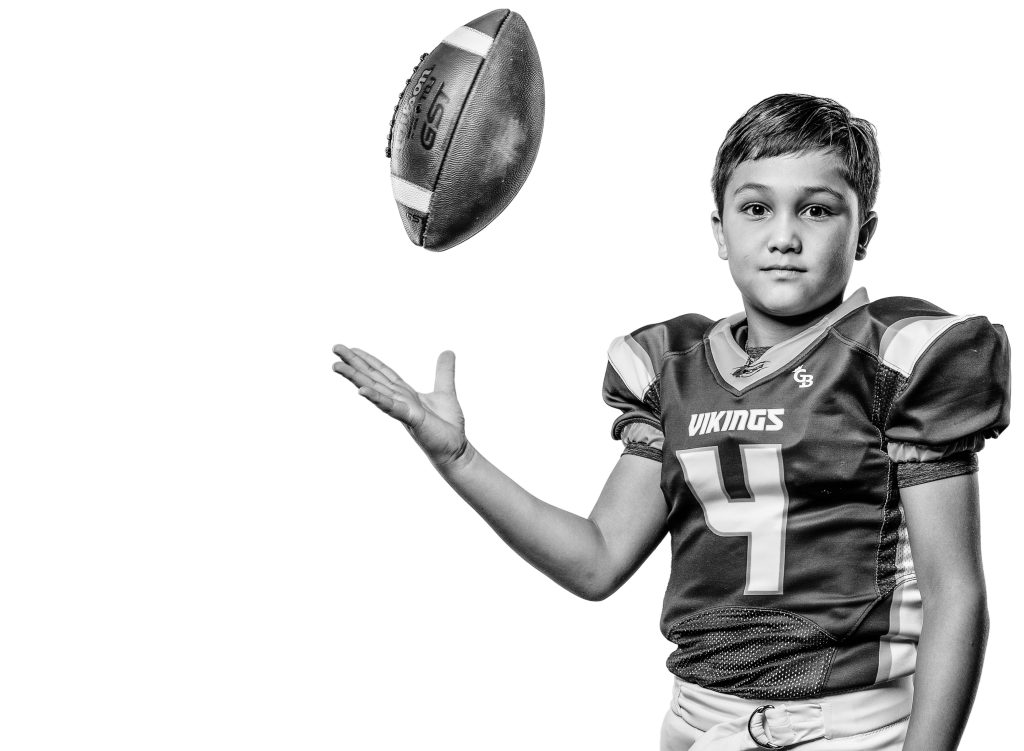
He is a sixth grader at Sprague Middle School in Cypress, Texas, with Bridgeland High School waiting on the other side of eighth grade. He started playing at four, and the reason he gives is the reason most kids who last actually give: the people. “Fun and enjoy running and catching,” he said. “Team sport and spending time learning, growing and bonding with teammates and friends.” Eight years in, that has not worn off.
The Season That Asked for a Leader
Ou’s biggest challenge so far did not arrive as a defense. It arrived as a roster.
“Stepping into a brand new team that was rebuilding around me at QB,” he said. Rebuilding around him — which at that age means new faces, unfamiliar timing, and teammates who in some cases were learning the sport itself. The easy move for a young quarterback in that spot is to shrink, run the plays, and wait for the group to catch up.
He did the opposite. “I stepped up to be a leader and earned respect from new teammates and help guide new players to football.”
That is a rare sentence to read on a middle school questionnaire, because it describes work that never shows up in a stat line. It also explains why, when asked to name his strengths, Ou listed leadership first, ahead of anything physical: great leadership, mental and physical toughness, and high self-confidence. He built the first one on a team that needed it before he had any obligation to.

Fourth Down, Fourth Quarter, Nothing Open
Ask him for the play he would keep, and the details come out in order, the way they do when someone has replayed it a few times.
Bitter rival. A team that had been a problem every single year. A dogfight of a game with tempers running hot. Fourth down, fourth quarter.
“I took the ball outside, looked downfield and saw nothing available,” Ou said. So he beat the linebackers to the edge, turned it upfield, and ran through a defender at the five-yard line to score and put the game out of reach.
The instructive part is the middle of that sentence. He looked downfield first. The read came before the run, and the run only happened because the read said it should. That is the difference between a quarterback who scrambles and a quarterback who decides — and at the youth level, that difference tends to predict a lot about what comes next.
Two Coaches, One Standard
Ou credits two people, and the way he describes them explains a good deal about how he approaches the game.
The first is Coach Sok — his dad. “He taught me every aspect about football,” Ou said. “He has introduced me to players and mentors who played at the highest levels. He treats me like a player and not just his son and expects me to earn and work for my spot.”
That last line is the whole philosophy in one sentence. Nothing is handed over at home. The job still has to be won.
The second is Coach Zach Barker of QB Division in Katy, Texas, who handles the technical and mental side. “He has taught me how to break down defenses and helped with my mental game,” Ou said. Between the two of them, he says, the most valuable thing he has picked up has nothing to do with mechanics: “Both coaches have taught me how to overcome defeat and adversity on and off the football field.”

He has taken that development on the road. His camp résumé already includes Jenkins Elite in Highlands Ranch, Colorado and Sugar Land, Texas, Texas Tech Football in Lubbock, QB Magazine in San Diego, QB Universe in Dallas, and Elite 11 Academy in Massillon, Ohio this past April. For a sixth grader, that is a serious amount of reps against unfamiliar coaching in unfamiliar rooms — which is exactly the kind of exposure that separates players by the time high school arrives.
The quarterback he models himself on fits the pattern. “I like Patrick Mahomes because he is a leader on his team and shows great effort on each play,” Ou said. “He takes no plays off.” Not the no-look throws. The effort.
The Next Two Years
His goals are stated plainly, without inflation.
Short-term: be QB1 on the seventh grade A-team. Long-term: “build on what I’ve learned from 7th grade season and improve any short-comings to be the best I can be going into 8th grade and into high school. I want to compete at the highest level possible.”
Notice the word shortcomings. He is twelve months out from a season he has not played yet and has already built the assumption of things to fix into the plan.
Football is not the only thing on his calendar, either. Ou plays competitive select travel baseball year-round — third base, center field, pitcher, catcher, and shortstop — along with basketball and freestyle wrestling, with track and field on the list for middle school. At home there are two beagles and a younger brother whose flag football team Ou helps coach whenever he gets the chance.
He is, in other words, a kid who has found a lot of ways to keep competing. And a quarterback who has already figured out that the job is not just about being right. It is about making the other side wrong.
Building the Résumé
Liam’s story is already worth telling — the rebuilding season, the fourth-down run, the camp circuit from Colorado to Ohio. What a membership upgrade adds is a home for it.
Heading into the fall, an upgraded membership gives Liam a professionally designed athlete graphic, feature placement across QB Magazine’s channels, and a recruiting profile that grows with him season by season. That last part matters most at his age. The work he does in seventh grade is not going to be remembered by anyone in four years unless someone wrote it down — and a profile built now becomes a documented record of development rather than a page started from scratch when it suddenly counts.