

QB Magazine Athlete Feature
Most quarterbacks his age hedge. They talk about working hard, getting better, seeing where it takes them. Michael Anderson III skips all of that.
He wants it on the record that he believes he is the next big quarterback at Bishop Gorman High School — and in the entire Class of 2029.
That is a large sentence to attach to your own name at fifteen, especially at Bishop Gorman, where the quarterback room has a history and the standard is national. But there is a version of confidence that is just noise, and a version that comes with receipts, and the interesting thing about Anderson is how much of his story is about the unglamorous work nobody would brag about.
The Hardest Thing Wasn’t Football
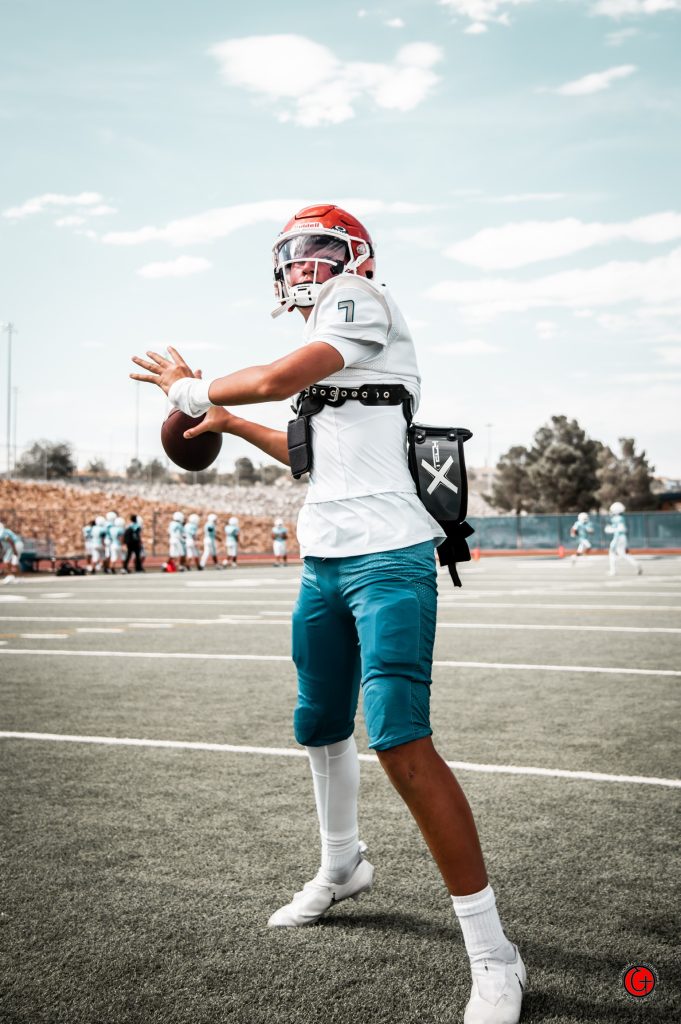
Ask him about the biggest challenge he has faced and he does not describe a defense, an injury, or a depth chart. He describes homework.
“The biggest challenge I faced was adjusting to the academic workload during my first year at Bishop Gorman,” the Class of 2029 quarterback said. “The amount of homework and studying required, including work on the weekends, was more demanding than I was used to.”
His solution was not complicated, which is usually how you know it was hard. He started staying after school. He met with teachers one-on-one. He asked questions instead of guessing.
“By putting in extra time, asking questions, and staying committed to improving, I was able to earn strong grades and become a more disciplined student,” he said.
That answer tells you more about a quarterback’s long-term odds than most highlight reels do. Plenty of talented players hit a wall in ninth grade. The ones who solve it by walking into a teacher’s classroom and admitting they need help tend to solve other things later, too.
Fourth and Forever
The football moment he keeps is the one where the ask was completely unreasonable.
Anderson got pulled up from the freshman team for his first JV game. Fourth and forever — his phrase, and a fair description of any down where the sticks are far enough away that the play call becomes a dare.
He hit a 45-yard post down the middle, in triple coverage, for a touchdown.
Triple coverage is the detail worth sitting with. It means he saw a window nobody else in the stadium thought existed, decided it was real, and put the ball there on a throw that has to be both fast and exact. In his first game at a level above his own. On a down where an incompletion was the expected outcome and nobody would have blamed him for it.
That is not a confidence-builder. That is confidence that already existed, finally getting a stage.
Coach Nash and the Truth Rule

Anderson has been on a serious development path for a while. His camp résumé includes Steve Clarkson, Steve Calhoun, the Change the Game Foundation, Rivals, UA Camp, Next Gen, UC Report, Elite 11, and college invite-only camps — a circuit that puts a young quarterback in front of unfamiliar coaching over and over, which is the fastest way to find out what actually holds up.
But the constant is Marcus Nash of Nash Performance Systems, who has trained him since middle school.
“He has had me since the start of middle school and has developed me into who I am today,” Anderson said. “The biggest thing for me and him is being truthful. What do we need to work on, what do you need to study, where are you struggling at. He always been there when I need him.”
Truthfulness as the foundation of a coaching relationship is a telling thing for a fifteen-year-old to name. It means somebody in his life is authorized to tell him he is not good enough at something yet — and that he keeps showing up anyway.
It also puts his bigger claims in context. A player who has spent years being told exactly where he is struggling is not guessing when he tells you where he stands.
Juice
Anderson’s definition of the position is almost entirely about presence.
“You must have great leadership on and off the field,” he said. “You need to know when to be joking and locked in ready to go. You have to practice like you play. You have to bring your own juice.”
Bring your own juice. Meaning: do not wait for the crowd, the score, or a teammate to generate your energy. Show up already carrying it.
Which explains his favorite quarterback. “I say my favorite QB is Michael Vick,” Anderson said. “I admire him the most because he just goes out on the field and gives everything he has every single play.” Not the arm strength. Not the escapability. The motor.
Eleven years into playing the game — he started at four, inspired by watching his dad — the thing he says he enjoys most is still the simplest one available. Winning. That, and being the guy the room looks at.
The List
His goals come in two tiers, and both end the same way.
Short-term: earn his first offer, start on varsity, and keep God at the center of his life. Long-term: become a great college quarterback, get drafted, and keep God at the center of his life.
The repetition is not accidental. It is the one item on the list that does not depend on a coach’s decision, a growth spurt, or a scout’s opinion — and he put it on both.
Everything else is still to be earned, and he knows it. Bishop Gorman does not hand out starting jobs, and the Class of 2029 is deep. Anderson has said out loud where he intends to end up. The next two seasons are the argument.
Building the Résumé: Why Upgrading Your Membership Matters
Michael’s short-term goal is specific: his first offer, and a varsity starting job. Both are decided by people who have to know he exists first.
Heading into the fall, an upgraded QB Magazine membership puts a professionally designed athlete graphic and feature placement in front of an audience that reaches past his own following — coaches, trainers, and programs who were not already searching for him. He has already done the hard part by putting himself in front of unfamiliar evaluators at Clarkson, Elite 11, Rivals, UA, and the invite-only circuit. Feature coverage is what makes that work travel after the camp ends.

The timing matters too. Michael is a sophomore, which is the window where a recruiting profile stops being a formality and starts being the thing coaches actually pull up. A profile built now grows with him — every camp, every varsity snap, every measurable that moves gets added to a record that already has history behind it, rather than one assembled from scratch during junior year when everybody else is scrambling to do the same thing.
And there is the part that outlives recruiting entirely. Michael says he intends to be the next big quarterback out of Bishop Gorman and out of the Class of 2029. Claims like that are only worth anything if somebody was keeping track along the way — the fourth-and-forever post in triple coverage, the freshman-year grind that turned into strong grades, the years with Coach Nash. A membership is what turns that into a documented record instead of a story he has to tell people later.