
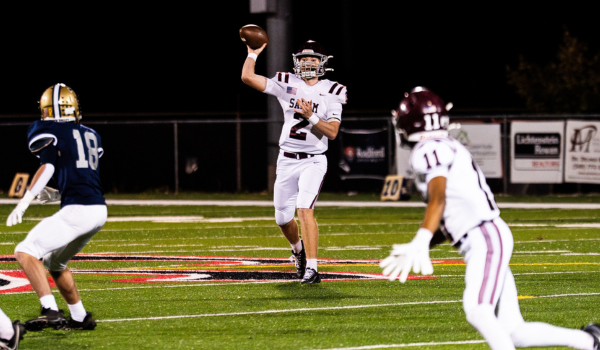
Tanner Overstreet — Quarterback, Class of 2027 — Salem High School, Salem, Virginia
Before Tanner Overstreet ever took a snap, he spent Sundays on a couch in Salem watching a screen split four ways.
“Kindergarten,” he said, when asked when football started for him. “Watching RedZone with my dad every Sunday.” That is the whole origin — a five-year-old and his father, every week, absorbing a highlight feed that cuts to whichever quarterback happens to be in trouble at that exact moment. Look at where he ended up. He did not fall in love with football generally. He fell in love with the part of the broadcast where somebody has to do something right now.
“Being the leader, the general of the offense,” he said of what draws him to the position. “Love the pressure.”
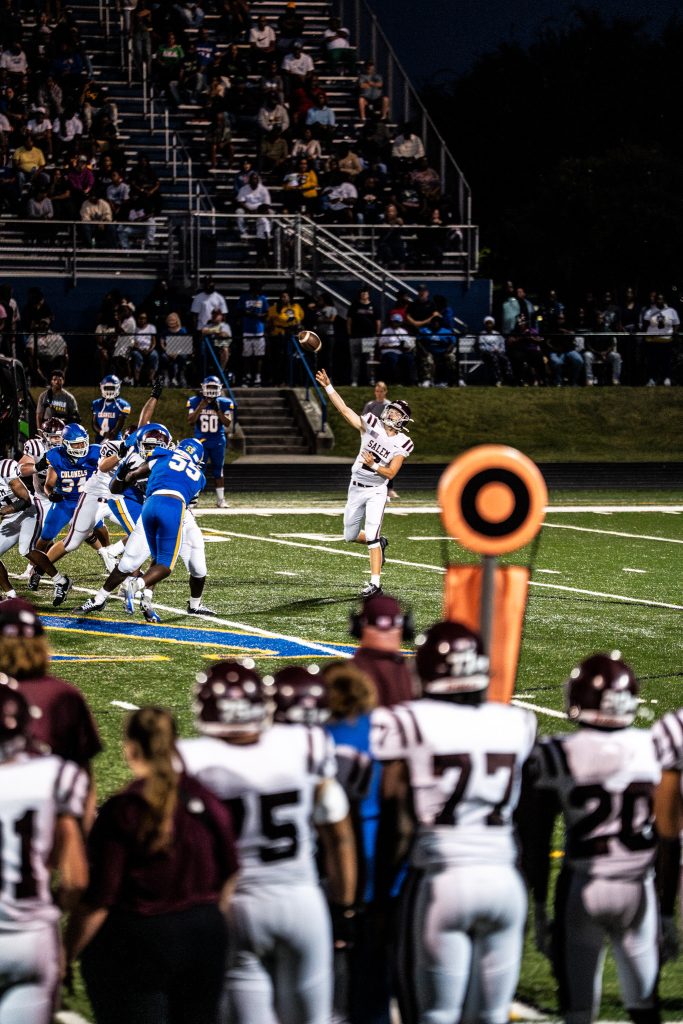
Quarterbacks say that. Overstreet has been asked to prove it. The hardest stretch of his life, by his own account, was not a loss or a depth chart. It was a broken collarbone — the specific kind of injury that takes a player out of the thing he uses to feel like himself and leaves him alone with the wait. He came out of it with an answer he did not have going in. “Got closer with God through the process, and it helped me persevere through the toughest part of my life,” he said.
That is a rehab story that is really about identity. A player who only knows who he is while playing loses himself when the pads come off. Overstreet found something underneath the position that held while the bone healed, and players who go through that tend to come back with a steadier floor than the ones who never had to look.
Ask what he wants a coaching staff to know about him and the answer has nothing to do with arm talent. “Being a trustworthy player, someone you can trust to make plays,” he said. “Leader. Playmaker.” Trustworthy comes first — before playmaker, before anything measurable. It is an unusual thing for a junior to lead with, and it is not a coincidence that the same word describes the person he credits most. “My dad,” he said. “He’s pushed me through all the ups and downs and is the only reason I am who I am.”
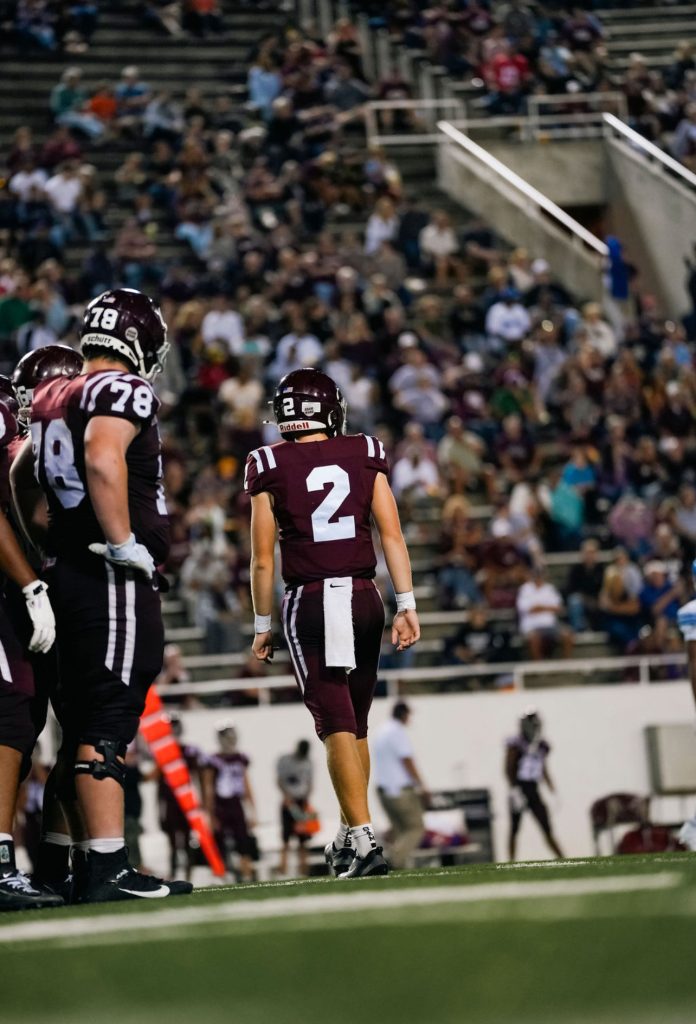
The model he studies is Josh Allen, and again the reasoning is specific. Not the highlights. The fearlessness. Overstreet describes him as a big, physical quarterback with a cannon for an arm who is not scared to make mistakes — which is the exact trait a young passer needs permission to develop, and the exact trait that dies quietest in players who get conservative after a bad rep.
The work has been steady. He has trained with Coach Fields of MTG Field Generals and tested himself at the Roanoke Mega Camp and on campus at Virginia Tech and Old Dominion, which is the right pattern for a Virginia prospect: local first, then in front of the staffs who can actually decide something. His near-term goal is physical — he wants to be at 205 pounds, adding the mass that lets a big-bodied thrower hold up across a full season. The longer one is the sentence every junior eventually has to say out loud.
“Twelve months, I want to be committed to a school.”
For a kid who learned the game watching quarterbacks get put on national television in their worst moment, that is a fitting place to arrive. The pressure was never the obstacle. It was the appeal.
Adding to the Résumé: What an Upgraded Membership Does This Season
Tanner said he wants to be known as someone you can trust to make plays. The gap between being that player and being known as that player is a communication problem, and it is the one an upgraded QB Magazine membership is built to solve.
The first piece is the custom graphics. Our design team builds player assets around the athlete specifically — his name, his position, his class year, his school, his measurables — the kind of clean, professional graphic that makes a page read like a prospect’s rather than a highlight dump. For a quarterback in a recruiting window, these become the things a coach screenshots and forwards to somebody else on staff, which is how most conversations about a player actually start.
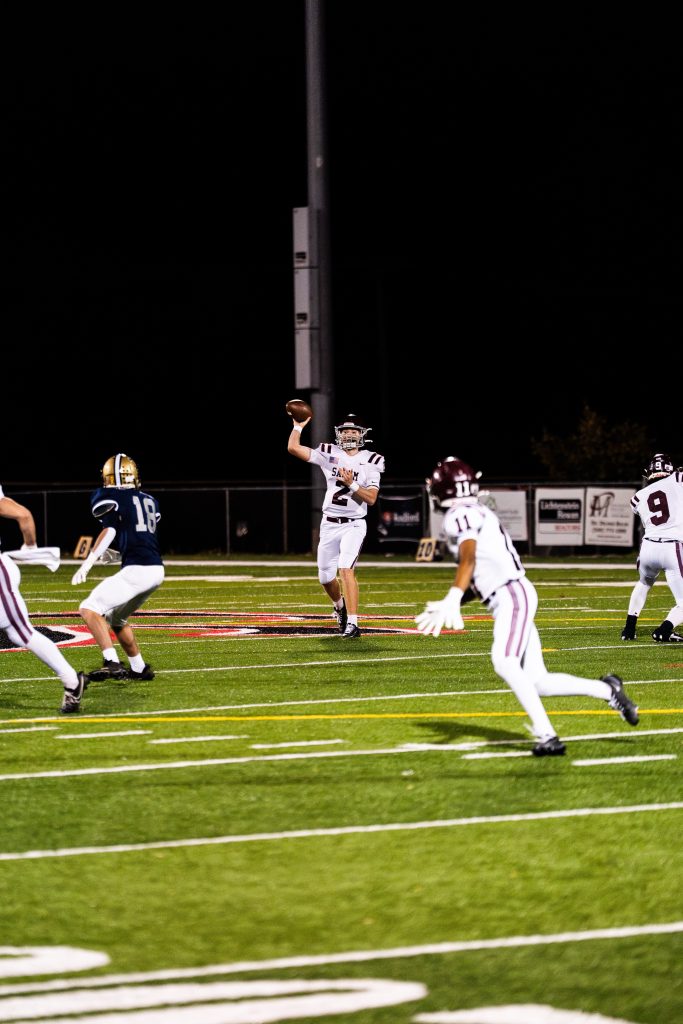
The second is reach. Upgraded members get their content shared across QB Magazine’s platforms, and the value there is the shape of the audience, not the size. Tanner’s own following is family, teammates, and people in the Roanoke Valley who already know exactly how he plays. Ours is built out of coaches, trainers, camp directors, and recruiting staff who follow a quarterback publication on purpose. Those are the people who need to see the name, and they are not going to find it on their own.
What makes it work is repetition. A single post is a moment. A feature, a set of graphics, and a profile that keeps getting updated through a season turn into something a staff can actually evaluate — and by the third or fourth time a name crosses a recruiter’s feed, it stops being a stranger’s name. That accumulation is the real product. It is also why doing it across a full season beats doing it once.
And it stays. Camp reps get forgotten, film gets buried, seasons end. A published feature does not. Years from now, the record of a Salem quarterback who broke his collarbone, came back steadier, and said out loud that he loved the pressure will still be there in his own words — with his dad in it, right where he put him.
More info: quarterbackmagazine.com/memberships