
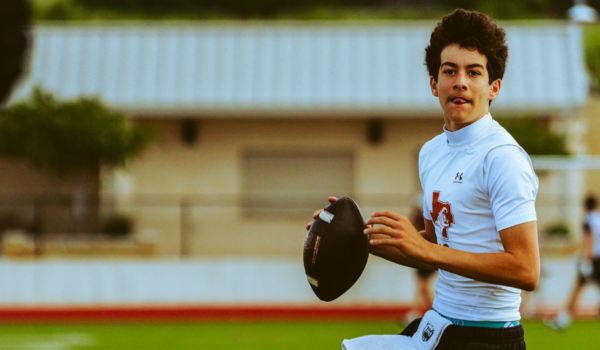
Micah Antoun knows exactly what people think when he walks into a room with a football in his hand.
“My biggest challenge is passing the eye test,” the Lake Travis freshman said. “Most people look at me and see a skinny guy with a football, but after they watch me a bit they understand what I can do.”
It is a remarkably level-headed way to describe an obstacle that frustrates plenty of quarterbacks twice his age. Antoun does not argue with the assumption. He does not resent it. He has simply built his entire approach around the second half of that sentence — the part where somebody watches long enough to change their mind.
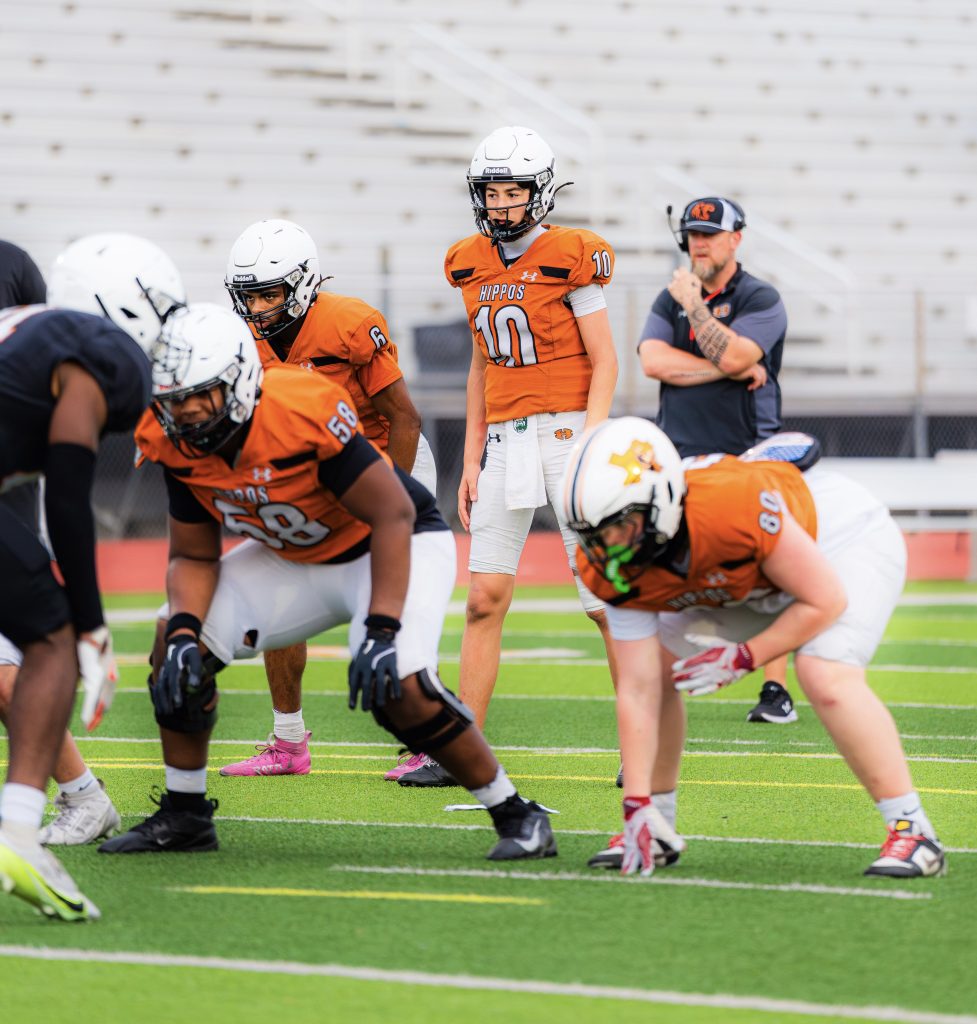
Built Since Second Grade
The Class of 2029 quarterback has been at this a while. He started playing the position in second grade, and the reason was sitting at his kitchen table.
“My first inspiration was my dad, who played QB in college,” Antoun said.
That is a specific kind of head start. Not a genetic one — a vocabulary one. Kids who grow up around a quarterback tend to learn the language of the position before they can execute it, and by the time the body catches up, the mental filing cabinet is already stocked.
Ask him why he still loves it, though, and the answer has nothing to do with lineage. “I love going out with my brothers and competing everyday,” he said. “I just love the game.”
His self-scouting report reads the same way — collective before individual. Leadership. Work ethic. Team mentality. First in, last out.
The Half That Broke the Game Open
Antoun’s team went 10-0 last season and finished as Texas 26-6A District Champions, and the game he points to is the one against Bowie.
It was 7-7 midway through the second quarter — the kind of score that means nobody has solved anything yet. Then safety Chase Waida came up with an interception, and Antoun got the ball and a chance to change the shape of the afternoon.
He threw a deep ball to the corner of the end zone to wide receiver Tatum Gold for the first score. On the following drive, he went deep again, this time to Alec Champion, who got them all the way to the one-yard line. Antoun kept it himself from there.
Two touchdowns to close the half. 21-7 at the break. 35-7 by the end.
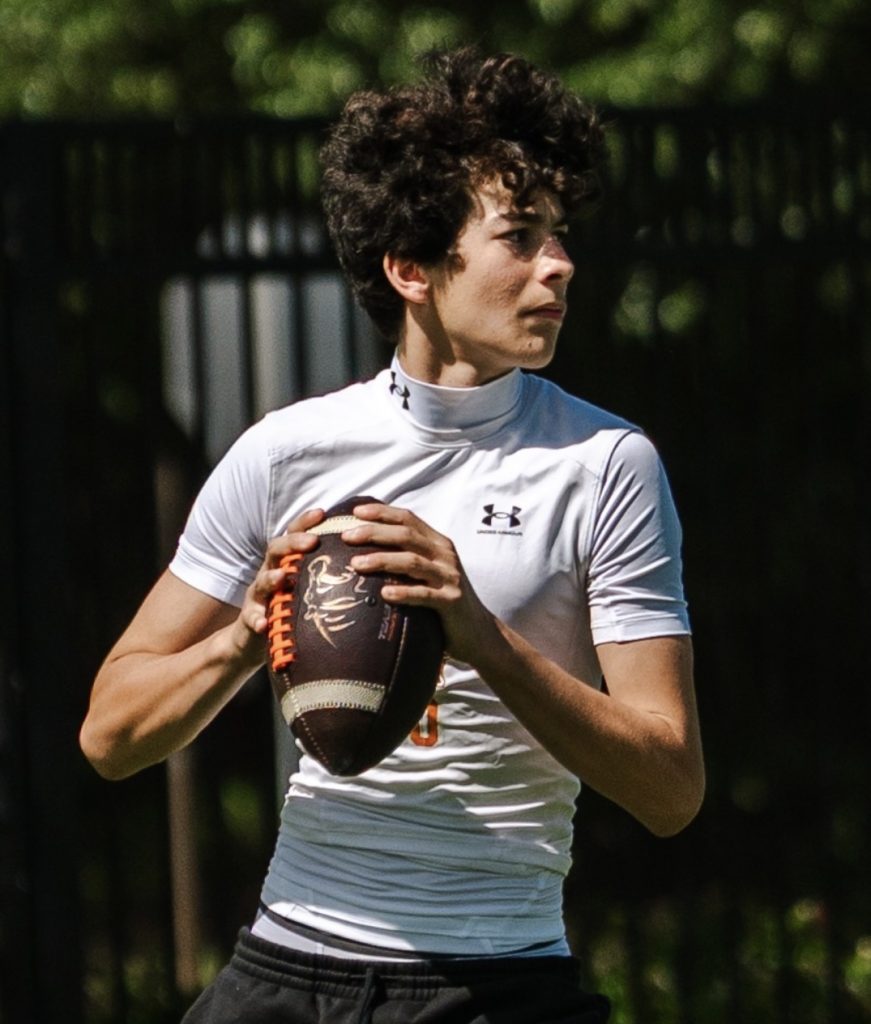
What stands out is not the arm — though back-to-back drives finished with shots to the end zone says plenty about the arm. It is the sequencing. He got a takeaway, converted it, and then immediately went back for more instead of playing it safe with a lead. Tied games become blowouts in windows like that, and quarterbacks who recognize the window are the ones who win them.
Notice, too, how he tells the story. Chase Waida gets named. Tatum Gold gets named. Alec Champion gets named. The only play Antoun claims outright is the one-yard keeper he could not hand off to anybody else.
Luca
The person Antoun credits most is not a coach. It is his brother.
“My brother Luca. I look up to him because he motivates me when I’m down and keeps me humble when I’m up,” he said. “He is one of the hardest working people I know. Even our high school coaches talk about it and say he is one of the hardest working athletes they’ve ever had in the program.”
Both halves of that first sentence matter. Plenty of athletes have somebody who picks them up. Fewer have somebody trusted enough to pull them back down — and fewer still would list that as a reason to look up to them.
The quarterback he models himself after fits the same profile. “Baker Mayfield, because he’s got that dawg mentality,” Antoun said. “He is a great leader, and never gives up no matter what situation he’s in.”
Mayfield is, not incidentally, a quarterback whose entire career has been a running argument with the eye test. Antoun probably did not pick him by accident.
Bigger, Stronger, Faster
His goal is stated in five words: “To get bigger, stronger, and faster!”
There is no talk of offers, rankings, or camp invites — just the honest acknowledgment that the physical piece is the piece that has to catch up, and the plan to go get it. For a freshman with three high school seasons still in front of him, that is precisely the right thing to be working on right now. Frame and speed are the two variables most responsive to disciplined work at fifteen, and they are the two that quiet the eye-test conversation permanently.
He closes his questionnaire the way he seems to approach most things — pointing outward.
“I’m grateful and blessed to have the best parents, coaches and teammates on the planet,” Antoun said. “I’m most grateful to my lord and savior Jesus Christ. None of this is possible without Him.”
Somewhere in the next couple of seasons, the frame is going to fill out and the eye test is going to stop being a conversation at all. When that happens, the thing worth watching is whether anything else changes. Based on how he talks about his brother, his receivers, and the people who got him here — it probably will not.
Building the Résumé: Why Upgrading Your Membership Matters
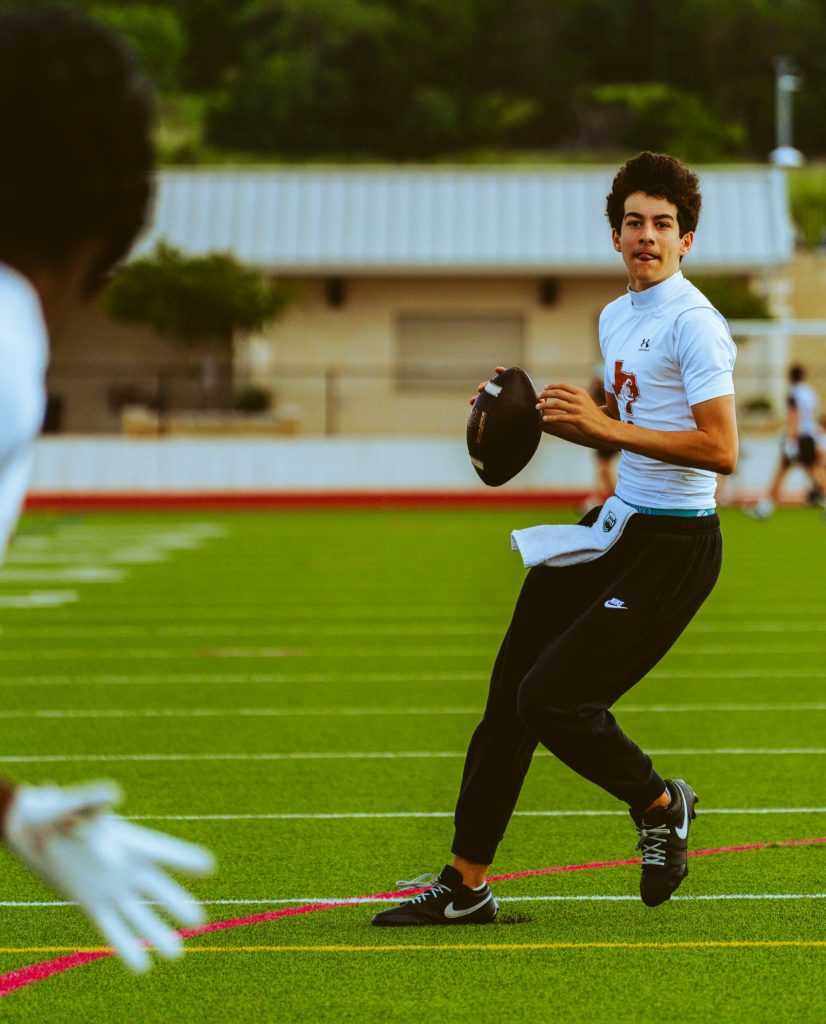
Micah’s challenge is not production. He has that. His challenge, in his own words, is getting people to watch long enough to see it — and that is exactly the problem a membership upgrade is built to solve.
Heading into the fall, an upgraded QB Magazine membership puts a professionally designed athlete graphic and feature placement in front of an audience that reaches well beyond his own followers. When QB Magazine shares a player, it lands with coaches, trainers, and programs who were not already looking. For a quarterback whose whole case is “watch the tape, not the frame,” extra sets of eyes are not a vanity metric. They are the entire argument.
The timing also works in his favor in a way it will not later. Micah is a freshman, which means a profile built now has four seasons to compound. Every camp, every district game, every measurable that moves as he gets bigger, stronger, and faster gets added to a record that already exists — rather than being assembled in a panic during junior year, when everyone else is doing the same thing at the same time. The athletes who look established as upperclassmen are almost always the ones who started documenting early.
And there is a version of this that outlasts recruiting entirely. Ten years from now, the Bowie game — the interception, the corner-of-the-end-zone throw to Tatum Gold, the deep shot to Alec Champion, the keeper from the one — exists either as a story Micah tells or as something written down with his name on it. A membership makes it the second one.